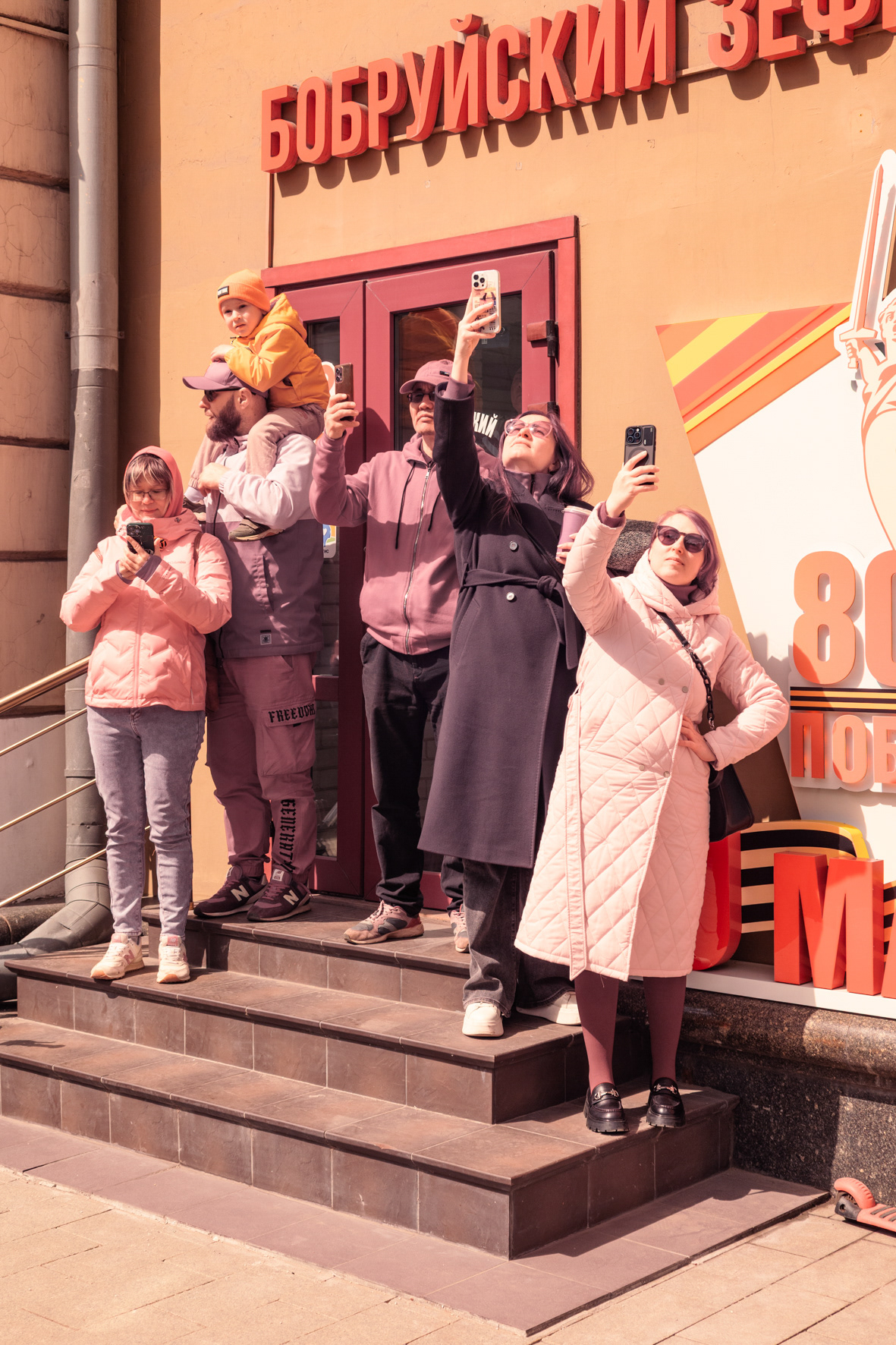
People stand on the steps outside a building in Moscow on May 9, 2025, holding up smartphones to photograph aircraft overhead or the military parade. Mounted on the facade is a decorative element marking the 80th anniversary of Victory Day, rendered in the colours of the St. George ribbon.

Children climb onto a historic artillery gun in Park Pobedy (Victory Park) while adults stand nearby. The park is one of the central memorial sites dedicated to the Soviet victory in the Great Patriotic War.
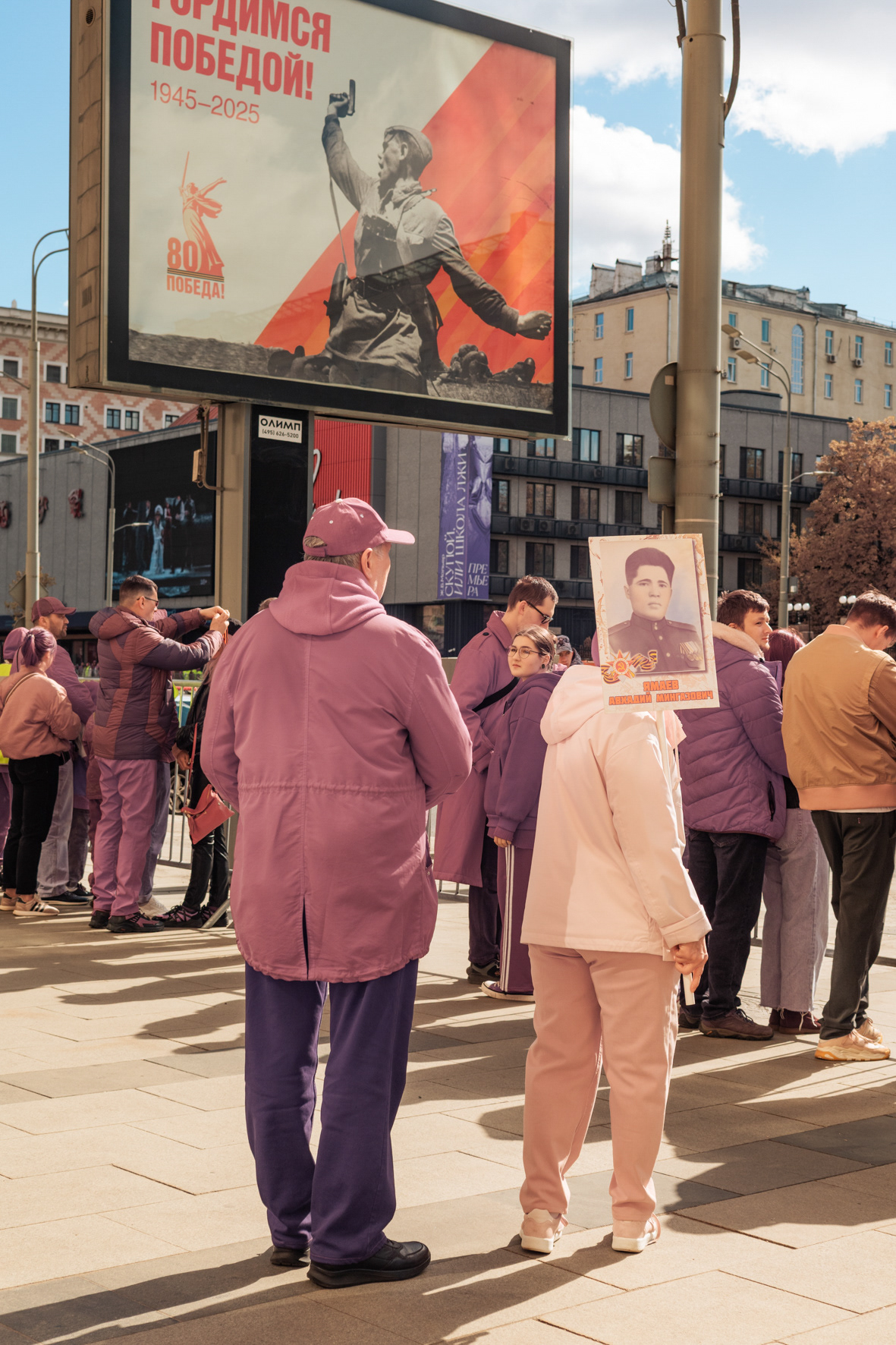
Beneath a giant billboard marking the 80th anniversary of victory, a woman stands holding a portrait of a veteran, similar to those traditionally carried by family members during the Immortal Regiment march. The initiative began as a form of personal remembrance and later became increasingly incorporated into official state memory politics. Above her, the slogan reads: “We Are Proud of the Victory! 1945–2025.”
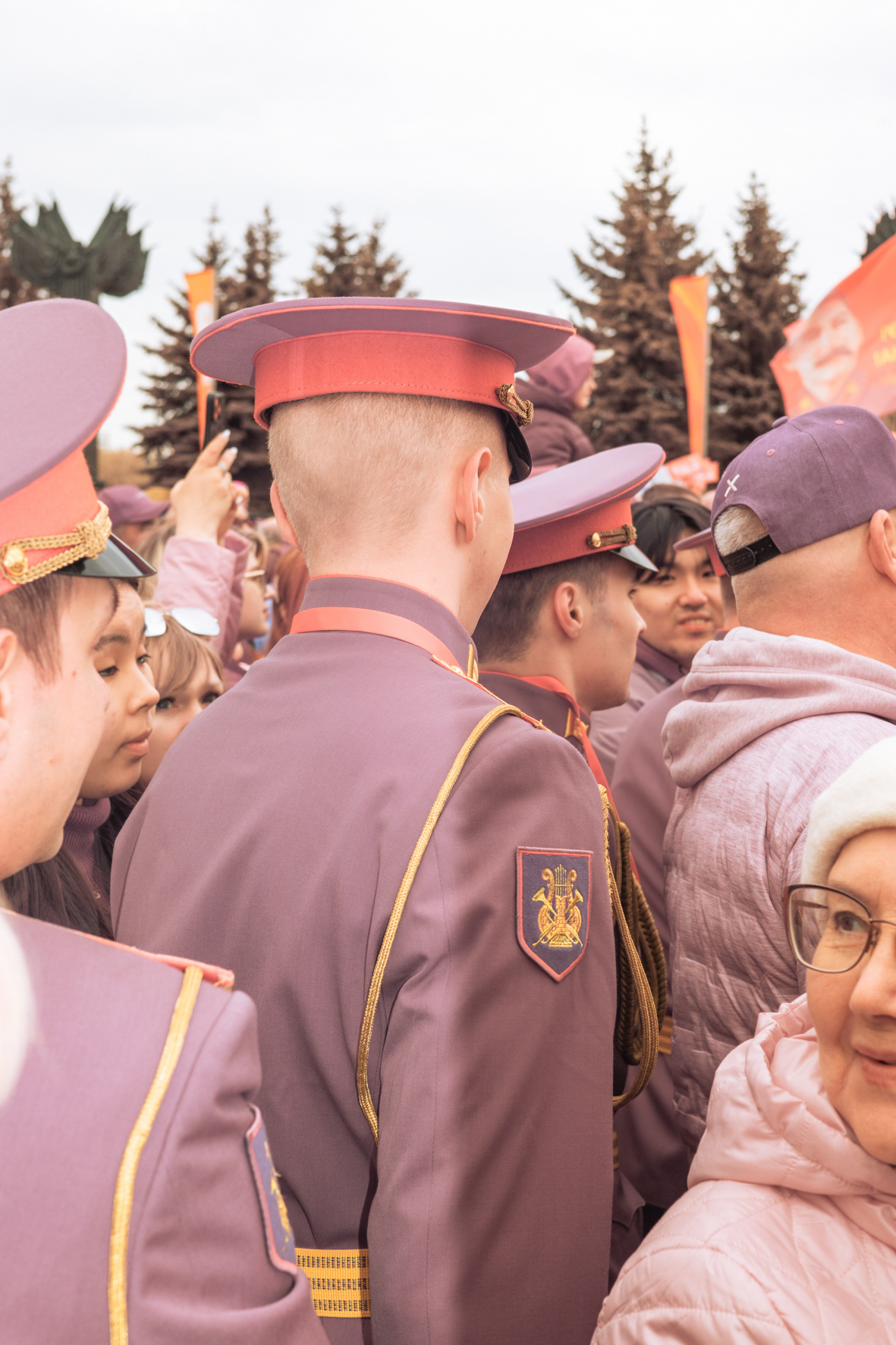
Several cadets in parade uniforms move through a dense crowd. On May 9, young uniformed cadets are a visible part of the public celebrations.
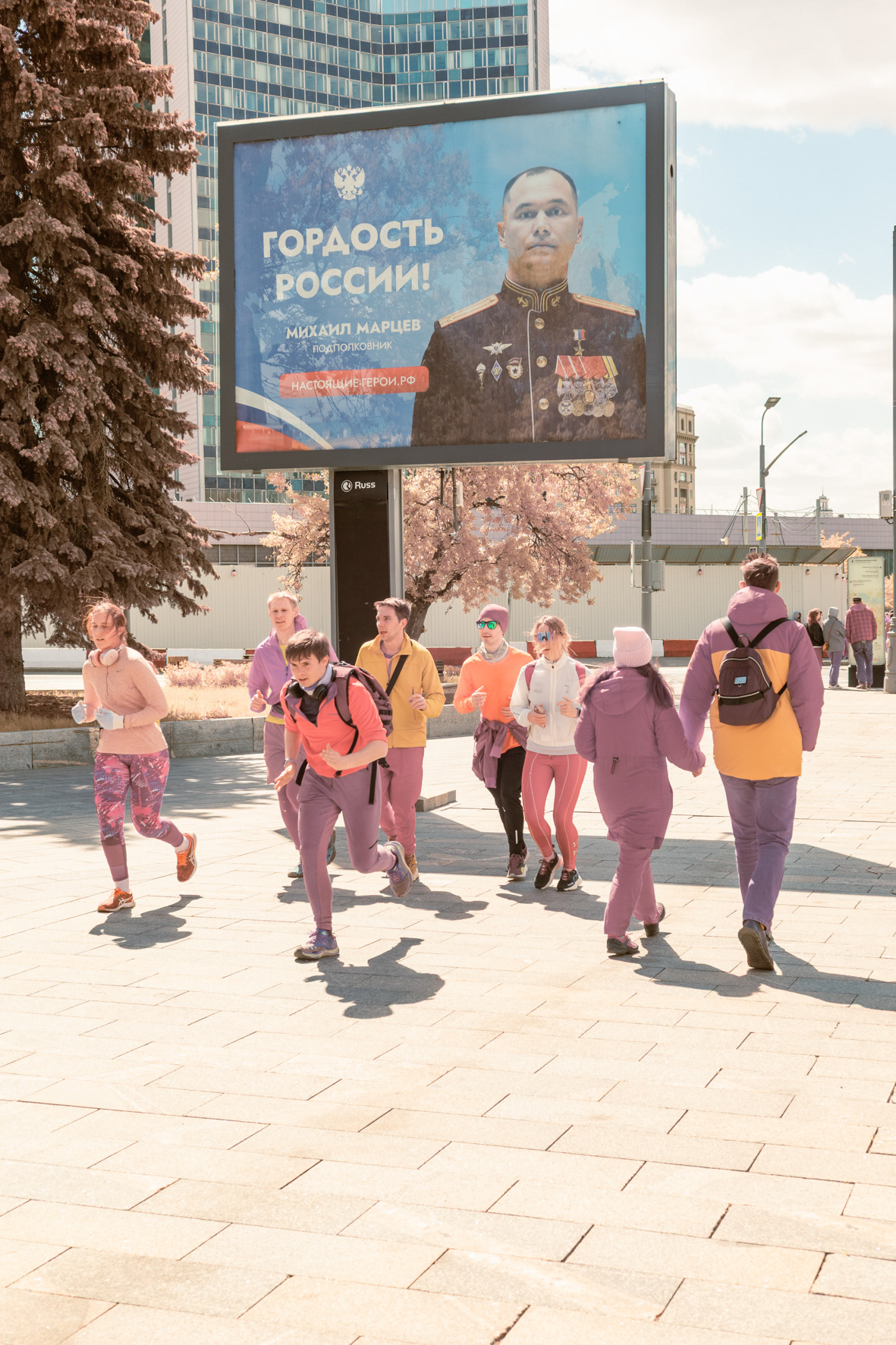
Young people in sportswear run past a large billboard featuring Naval Officer Lieutenant Colonel Mikhail Martsev, recipient of the title Hero of the Russian Federation and participant in the capture of Mariupol. Above him, the slogan reads: “The Pride of Russia.”
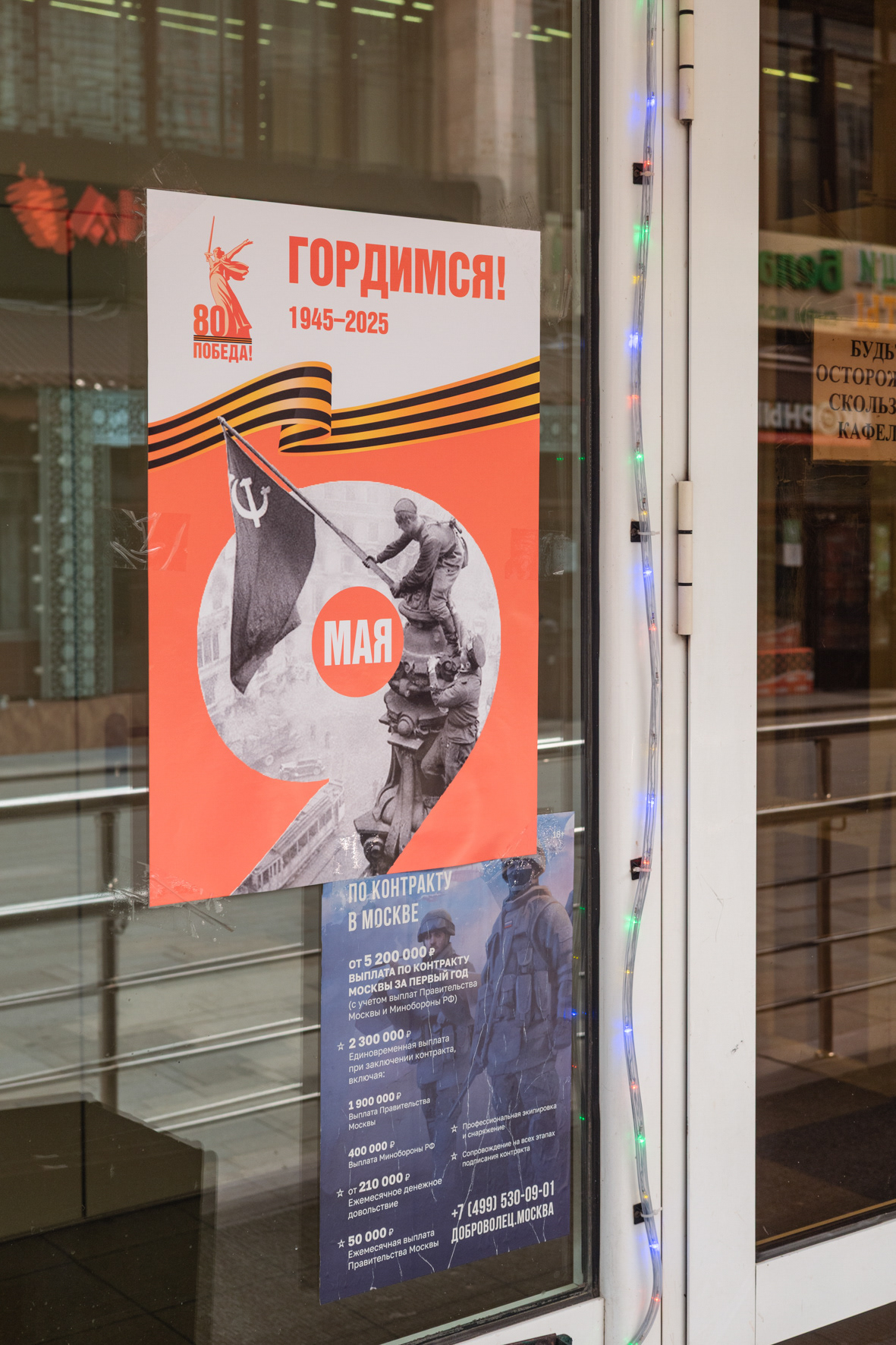
Two posters overlap on a glass door. Above, the iconic image of Soviet soldiers raising their flag over the Reichstag in Berlin. Below, a military recruitment advertisement offering substantial financial incentives for voluntary enlistment. Historical symbolism and contemporary wartime mobilisation intersect.
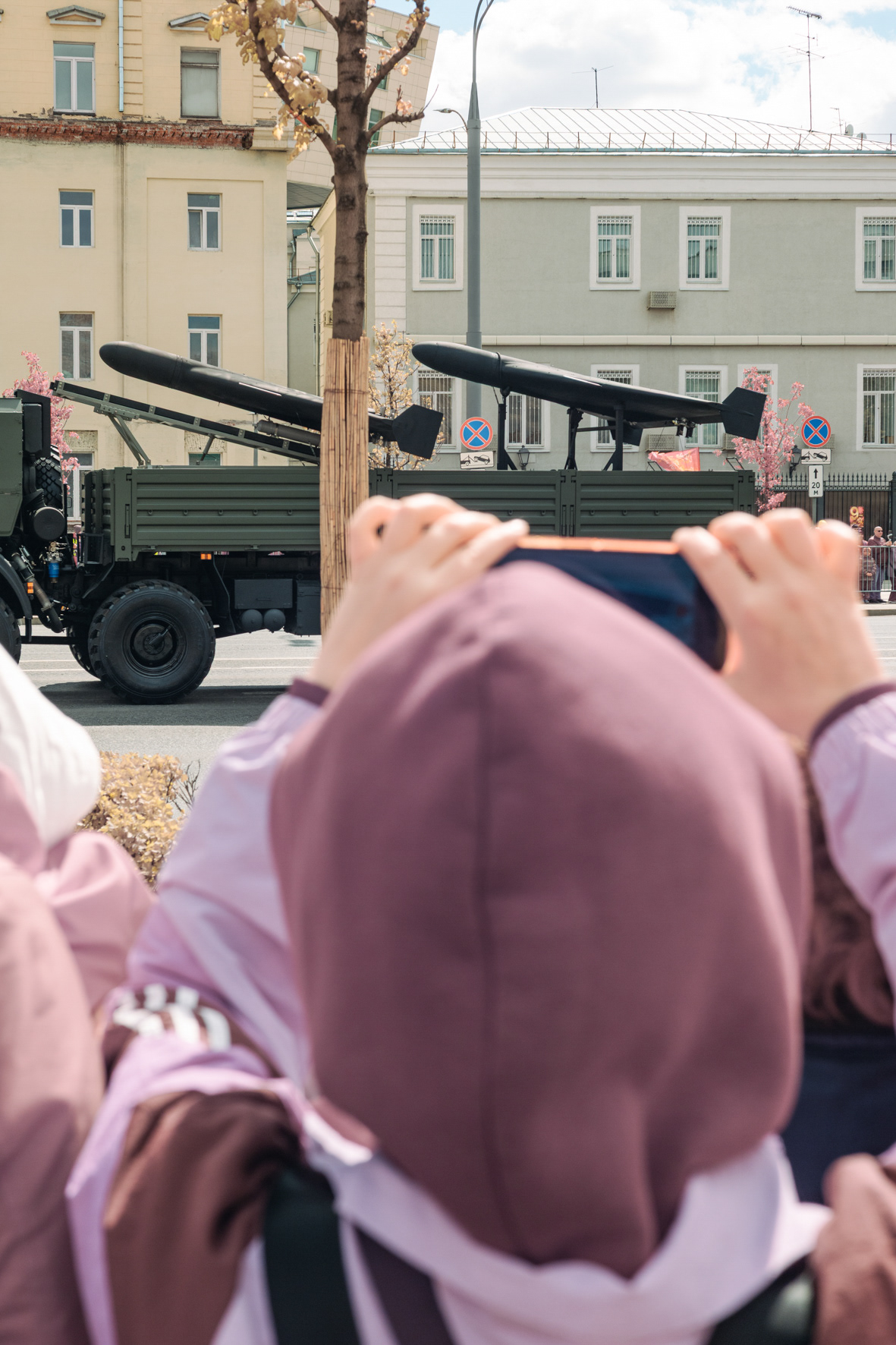
Victory Day parade. Several Geran-2 drones are mounted on a military truck. Since 2022, these drones have been widely used in Russia’s war against Ukraine.
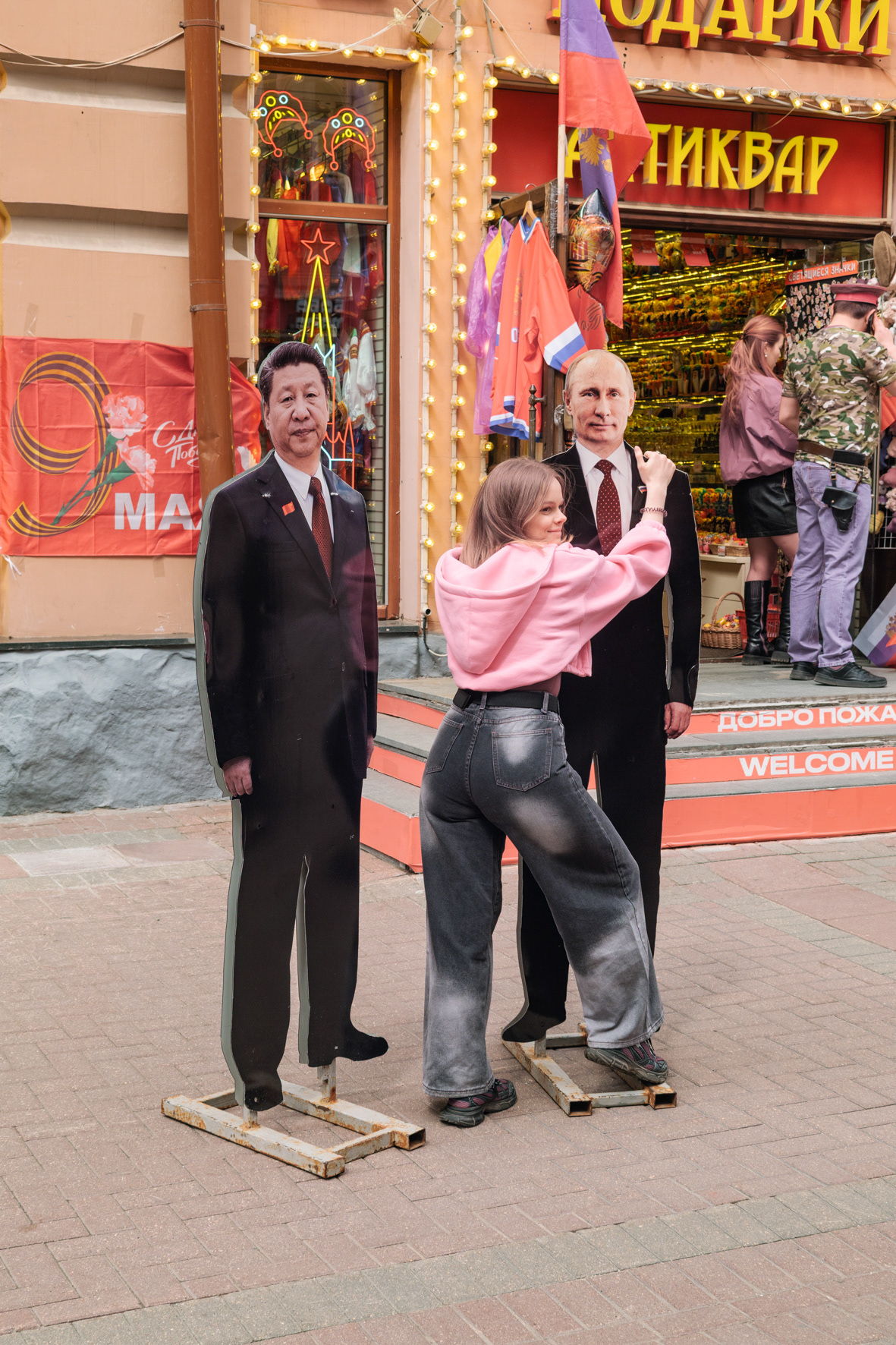
A young woman poses between life-sized cut-outs of Vladimir Putin and Xi Jinping on Moscow’s Arbat Street. In the background are patriotic decorations, Russian flags, souvenir shops, and a man wearing military-style clothing, part of the festive patriotic atmosphere surrounding May 9.
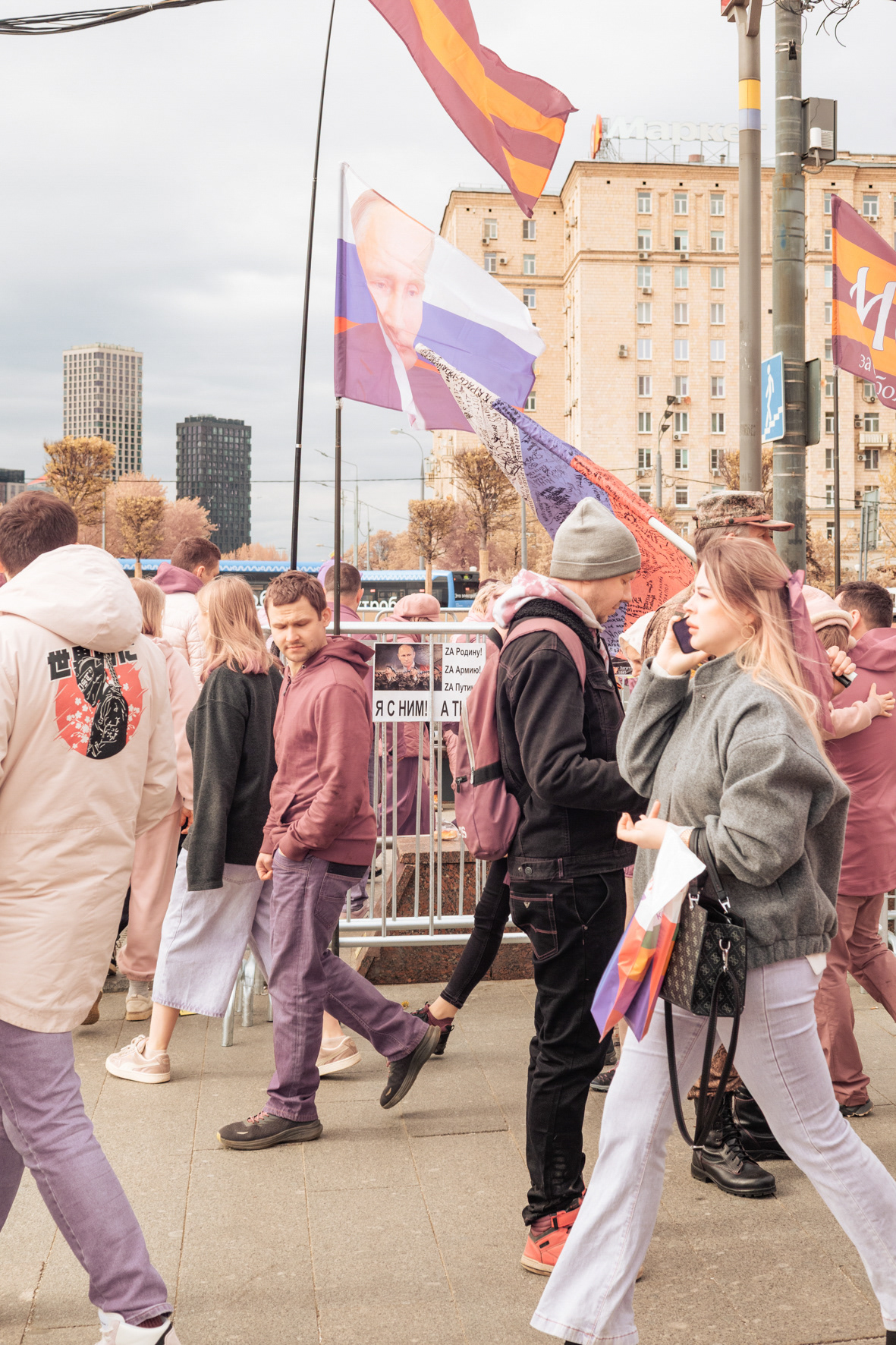
A crowd moves across Victory Square beneath flags bearing the image of Vladimir Putin and patriotic banners. Among them, a sign reads: “I’m with Him! Are You?” alongside the slogans “For the Motherland! For the Army! For Putin!” The word “ZA” (“FOR”) is deliberately written using the Latin letter “Z.” Since the beginning of the war against Ukraine, the letter Z has become one of the most prominent pro-war symbols in Russia.
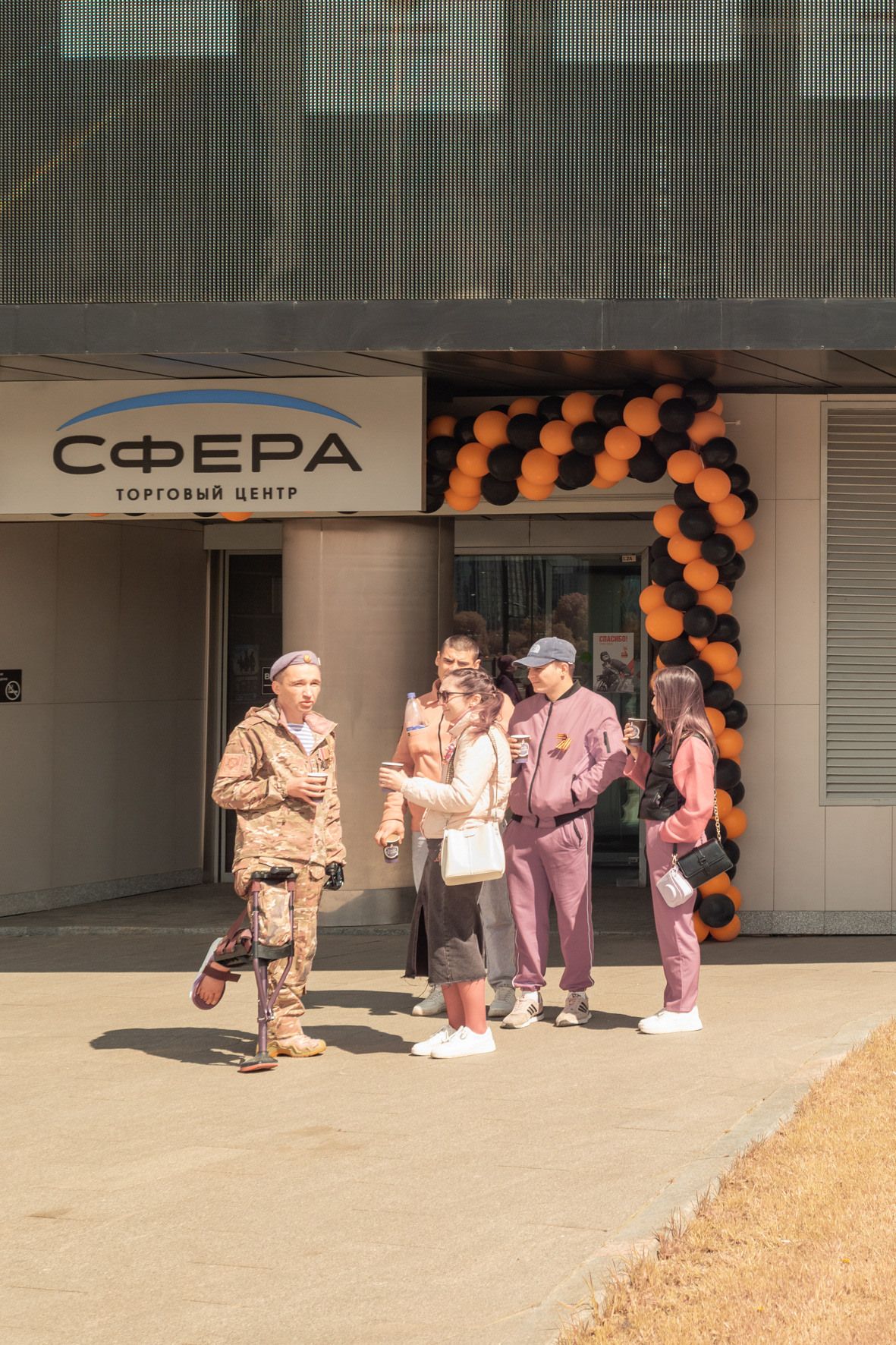
A young airborne forces officer wearing a blue beret stands outside a shopping centre. He has both a leg and an arm prosthesis. Nearby, a group of young people gather beneath black-and-orange decorations in the colours of the St. George ribbon. The consequences of war appear here within an everyday urban setting.
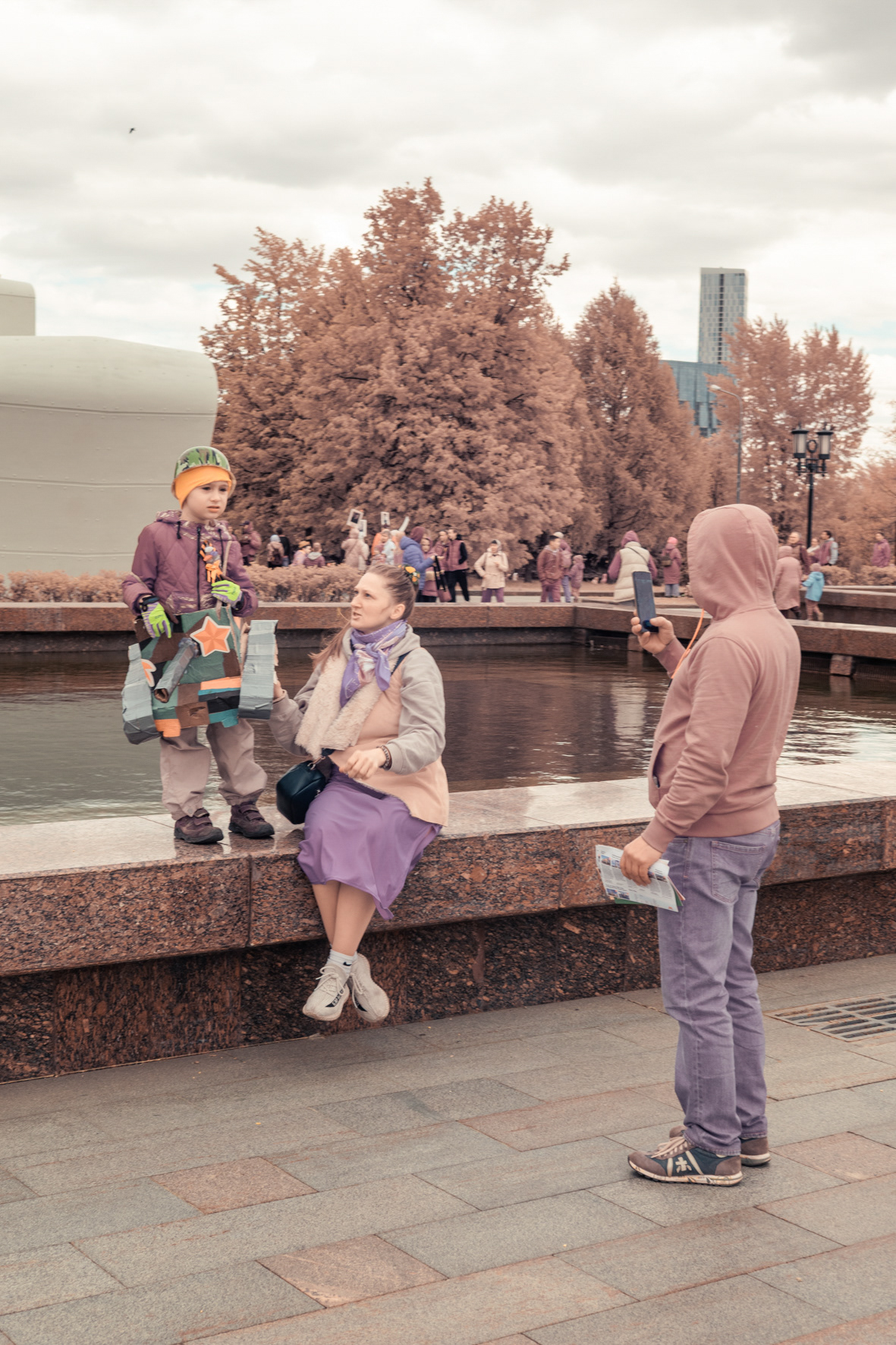
A small child stands on the edge of a fountain in Park Pobedy wearing a homemade tank costume decorated with a red star. A woman sits nearby while another person photographs the scene. In the background, people carry portraits of war veterans mounted on poles, images associated with the Immortal Regiment tradition.
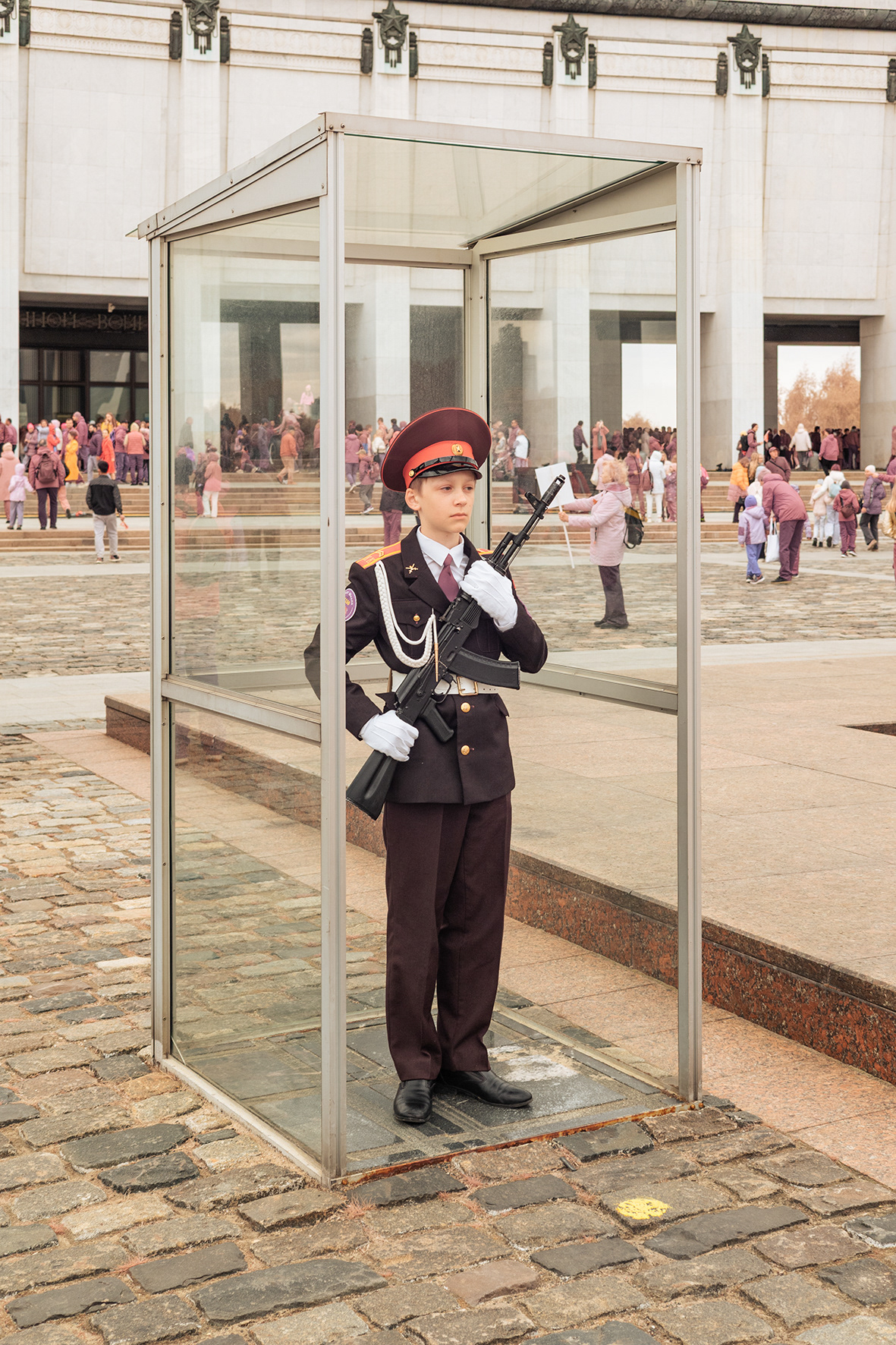
A young cadet in parade uniform stands guard with a rifle inside a glass sentry box in Park Pobedy. On May 9, youth cadets perform ceremonial guard duties and are publicly presented as heirs to the victory.
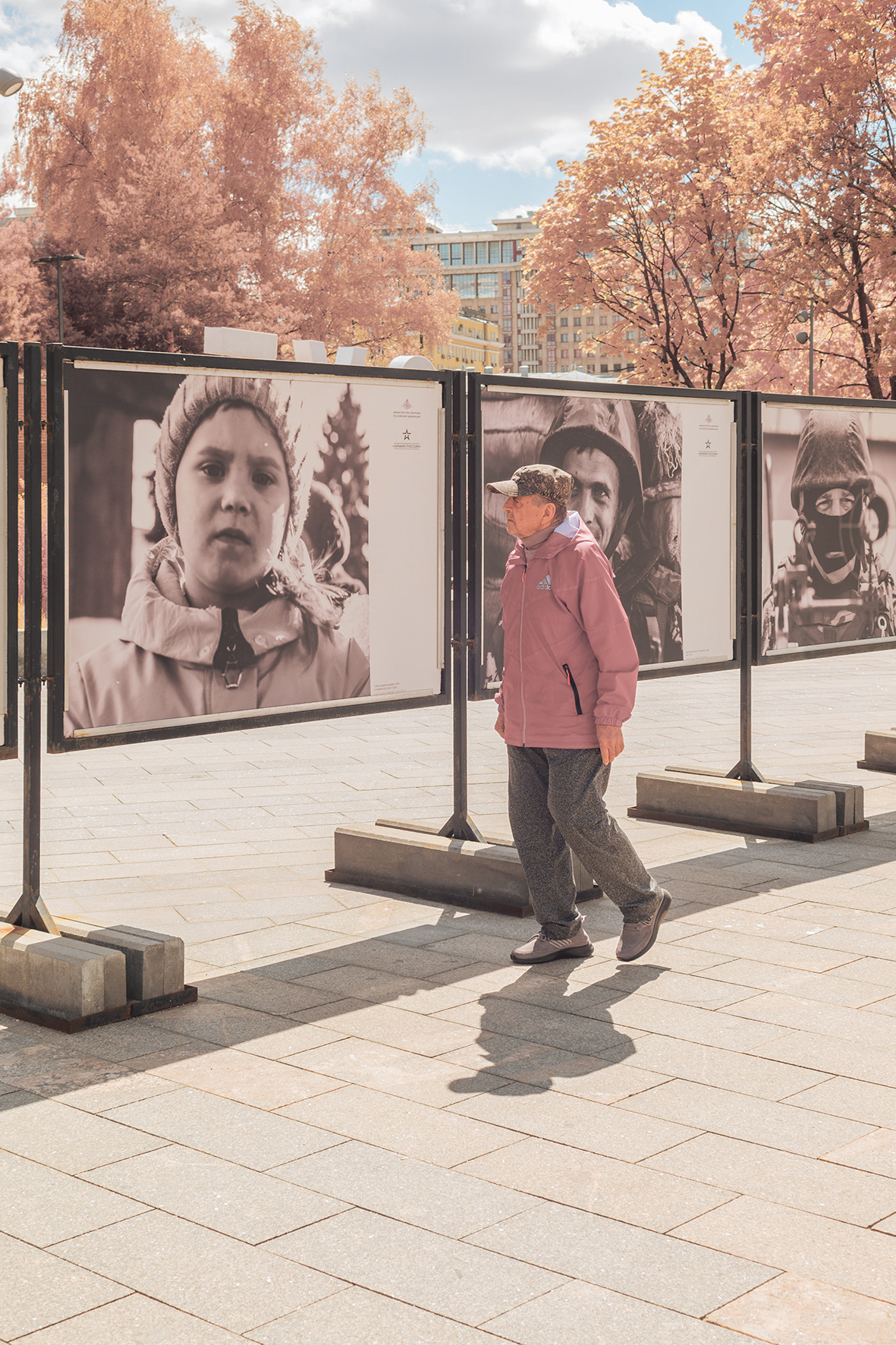
An elderly man wearing a military cap walks past an outdoor exhibition. The large black-and-white portraits depict children and armed fighters from war-affected regions of Ukraine. Similar exhibitions were visible throughout Moscow during the Victory Day commemorations of 2025.

A dense crowd gathers in Park Pobedy. In the foreground, a man wears a military-style cap. Behind him rises an Orthodox church crowned with a golden dome. Flags, military symbolism, and religious architecture overlap as different forms of public remembrance occupy the same space.
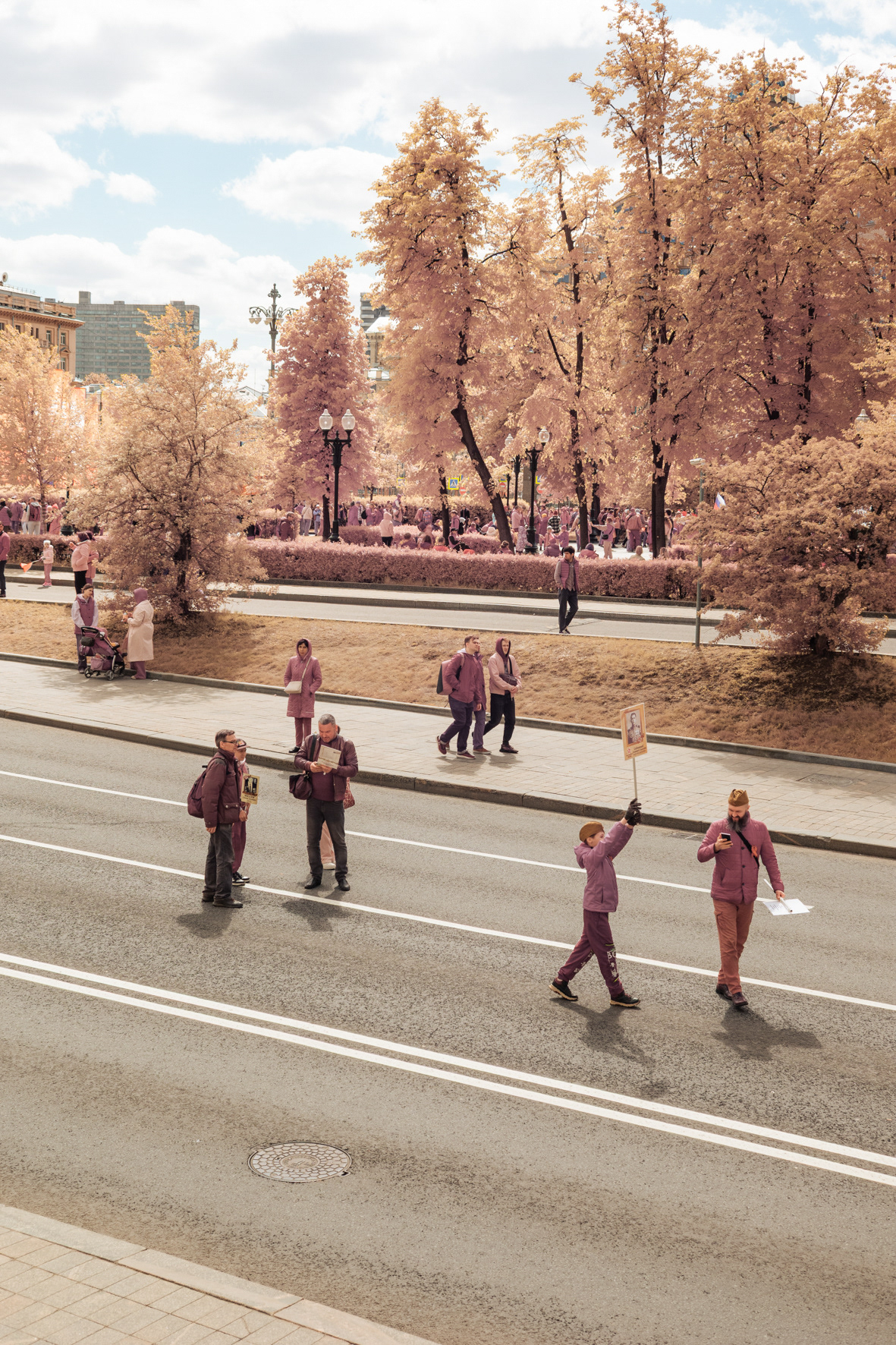
A child carries a portrait of a Soviet soldier through the street. The scene recalls the Immortal Regiment marches, in which participants carry photographs of relatives who fought or died during the Second World War. Memory appears here as something passed from one generation to the next.
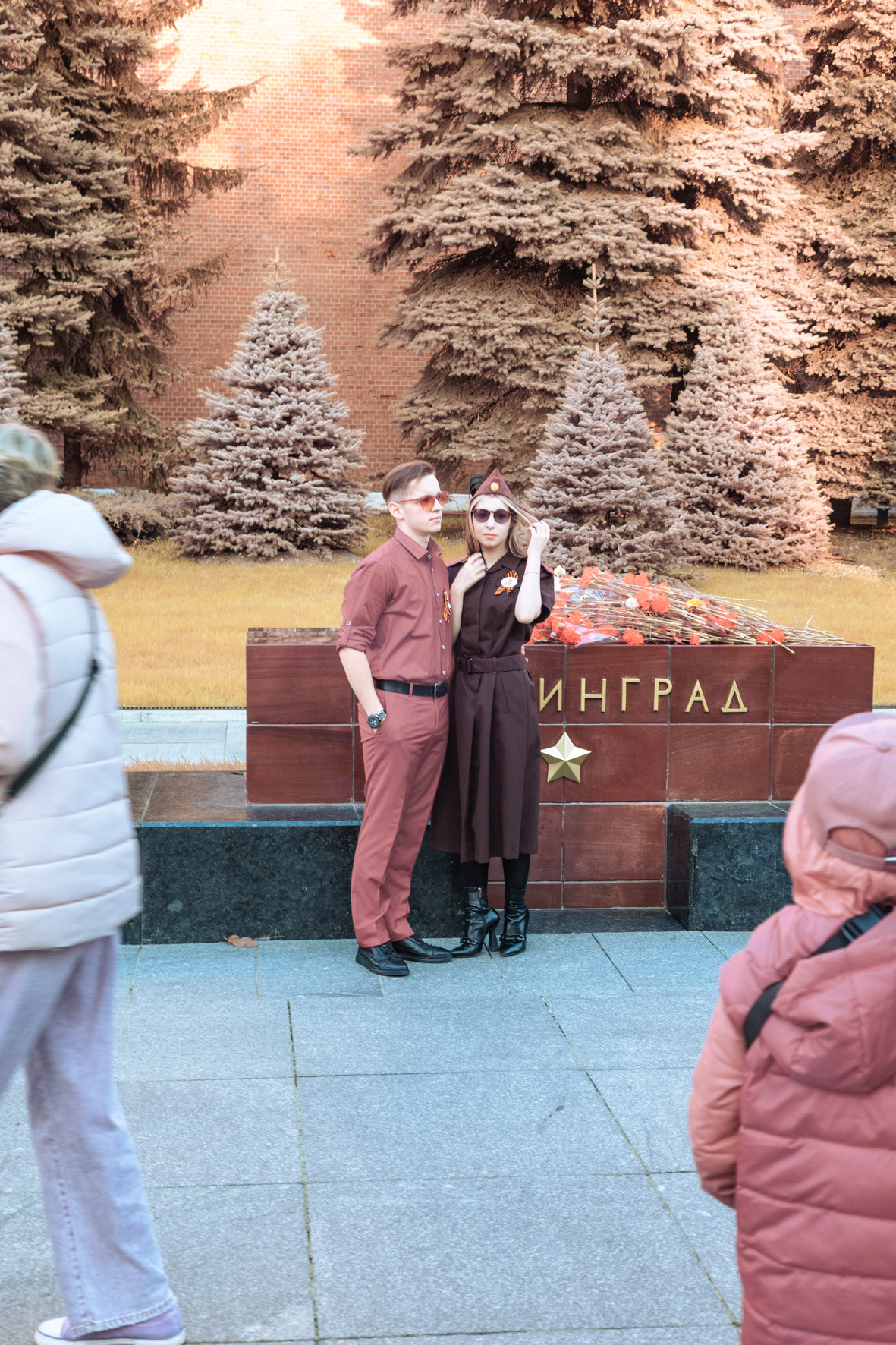
A young couple poses in Alexander Garden. The memorial complex includes stelae dedicated to the Soviet “Hero Cities”; here, the monument commemorates Leningrad. The woman wears a Soviet military cap, red carnations rest on the memorial, and the Kremlin wall rises behind them. The scene brings together personal remembrance, historical symbolism, and public self-representation.
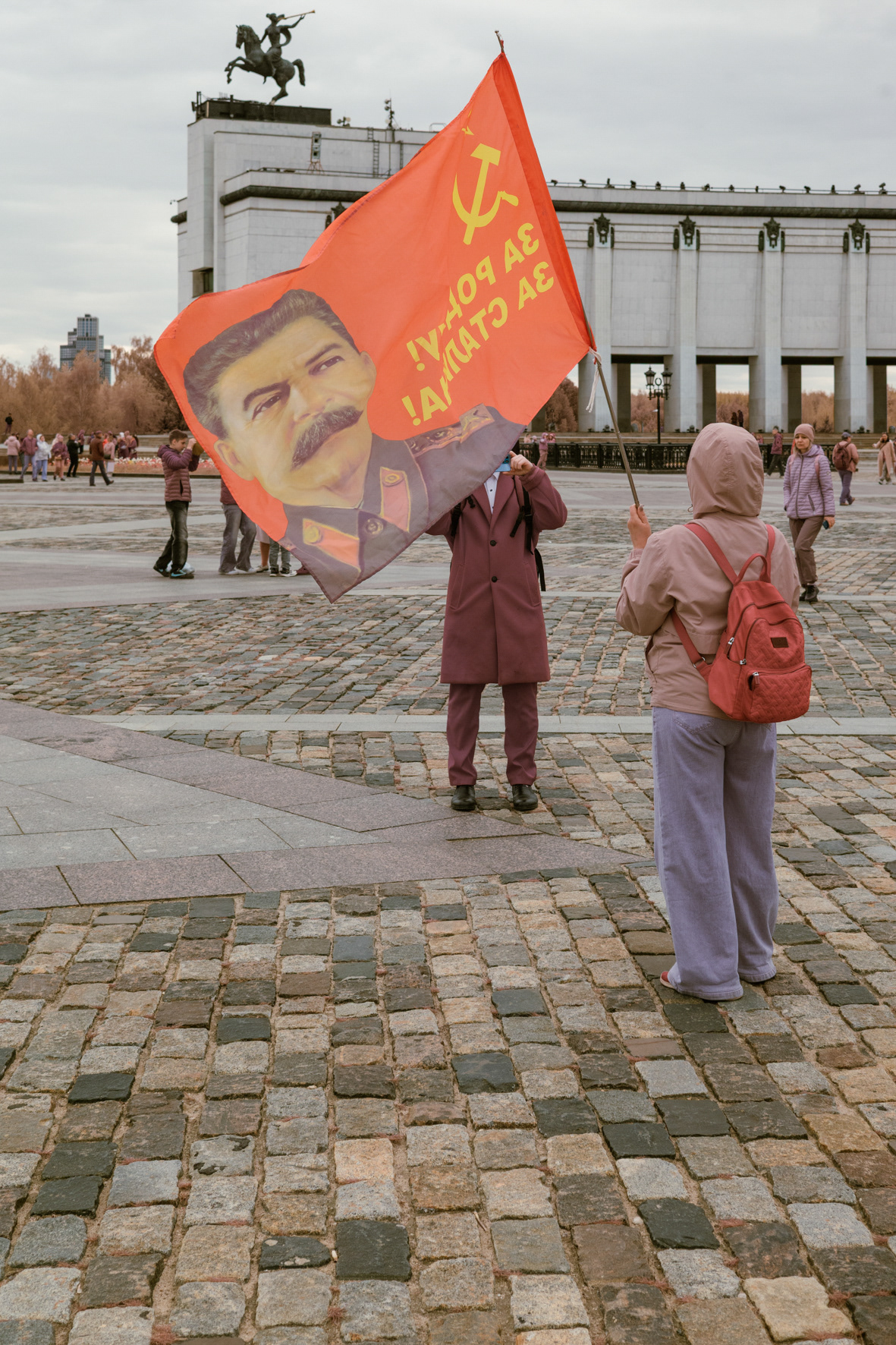
In Park Pobedy, a person holds a large red flag bearing a portrait of Stalin alongside the hammer and sickle and the slogan: “For the Motherland! For Stalin!” In the background stand the Museum of the Great Patriotic War and the equestrian statue of Saint George.
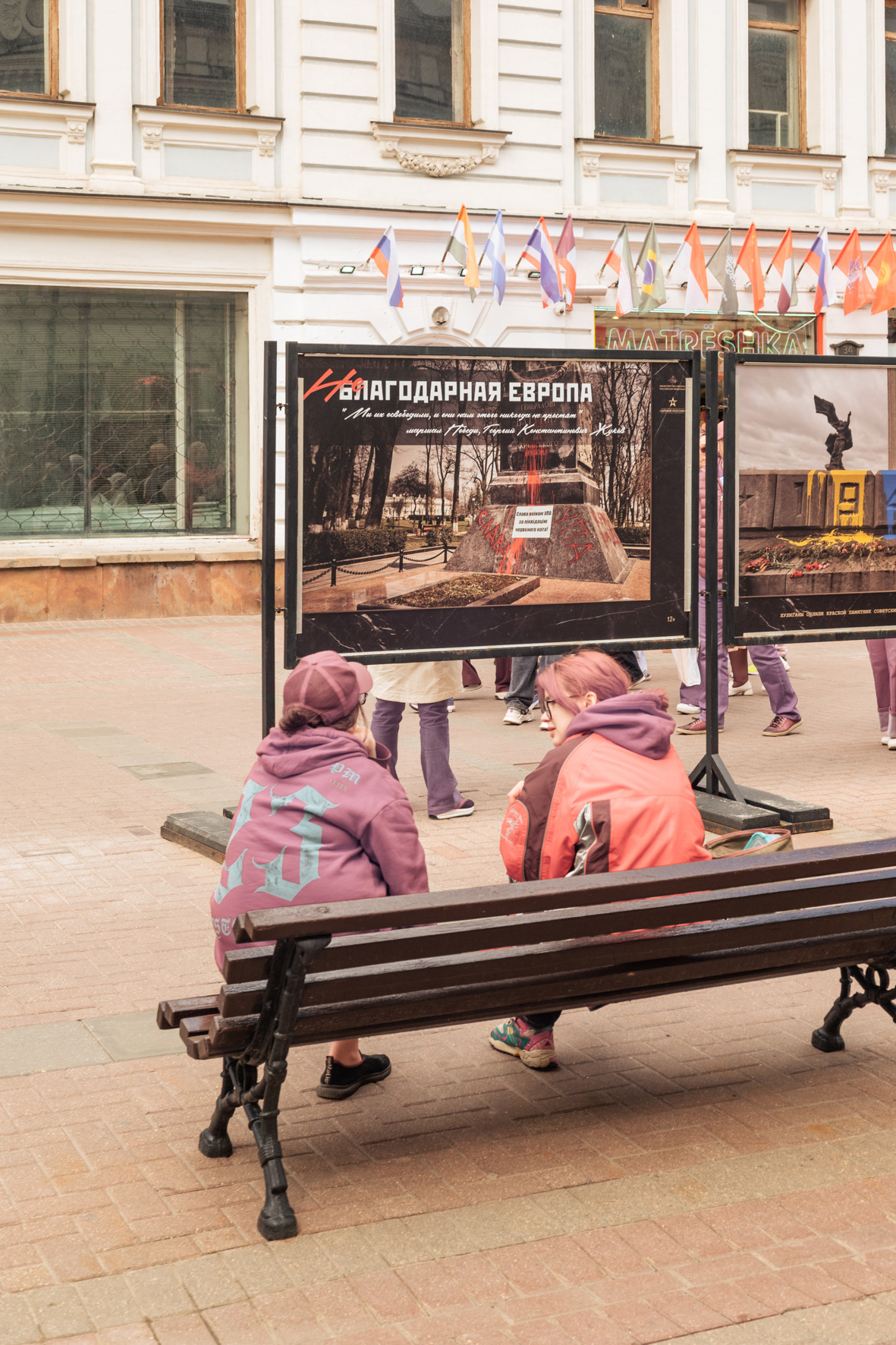
Two teenagers sit on a bench in front of an exhibition titled Grateful Europe. Below the title is a quotation attributed to Marshal Georgy Zhukov: “We liberated them, and they will never forgive us for it.” The exhibition presents photographs of damaged Soviet war memorials in various European countries.
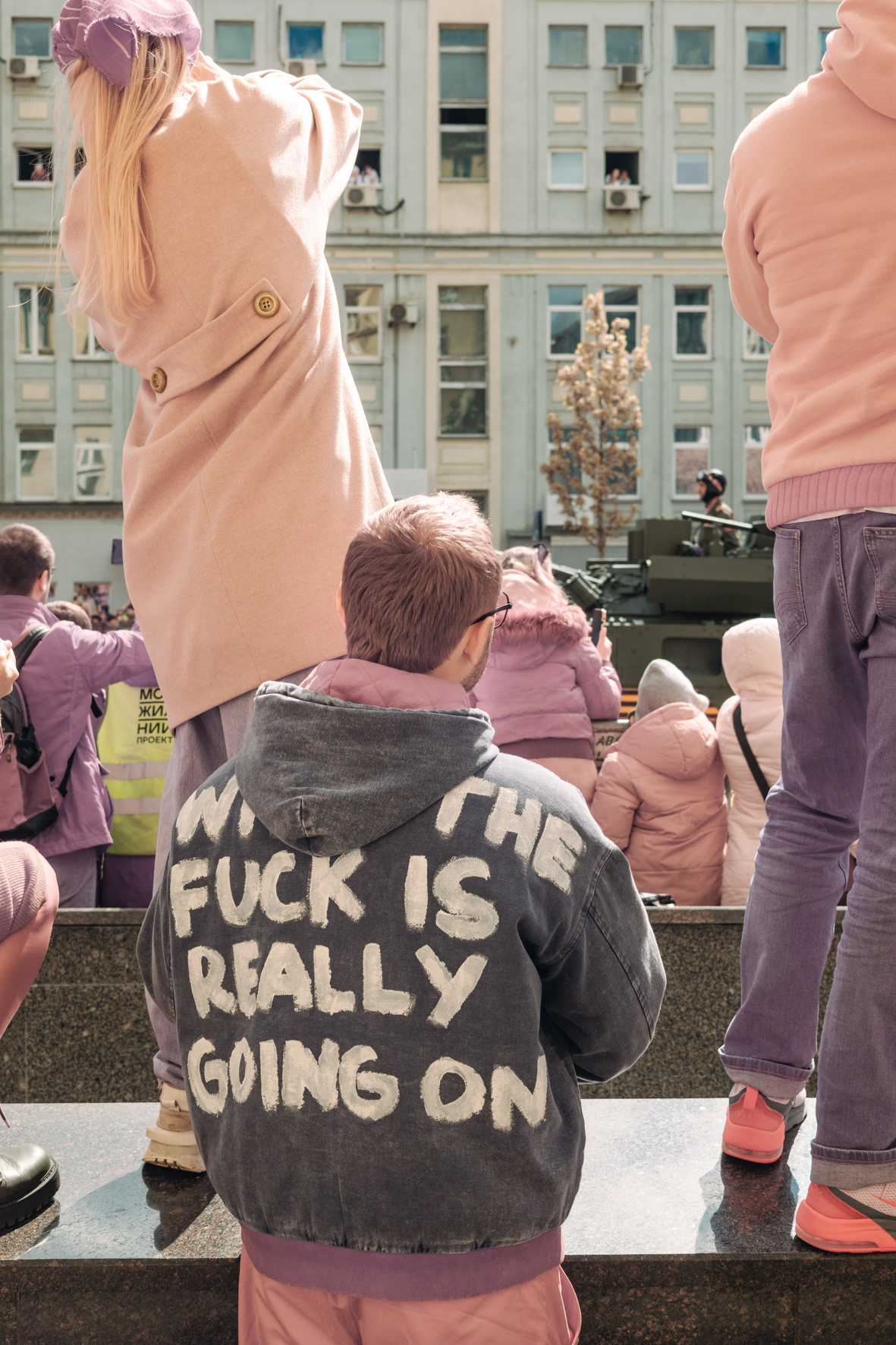
During the parade, a young man stands slightly apart from the crowd. Across the back of his jacket, large white letters spell out: “WHAT THE FUCK IS REALLY GOING ON.” Like everyone else, he watches the parade pass by.

View of the Kremlin: white tents, trucks, and the logistical infrastructure of a state ceremony. In the foreground are flowers placed along the wall of the Bolshoy Moskvoretsky Bridge, where opposition politician Boris Nemtsov was assassinated in 2015 and where an unofficial memorial continues to exist. Behind the stage of national remembrance, another, more fragile form of remembrance persists.